
The Room That Forgets
The ancient wood moved with dreadful ease, as though it had been opened countless times before

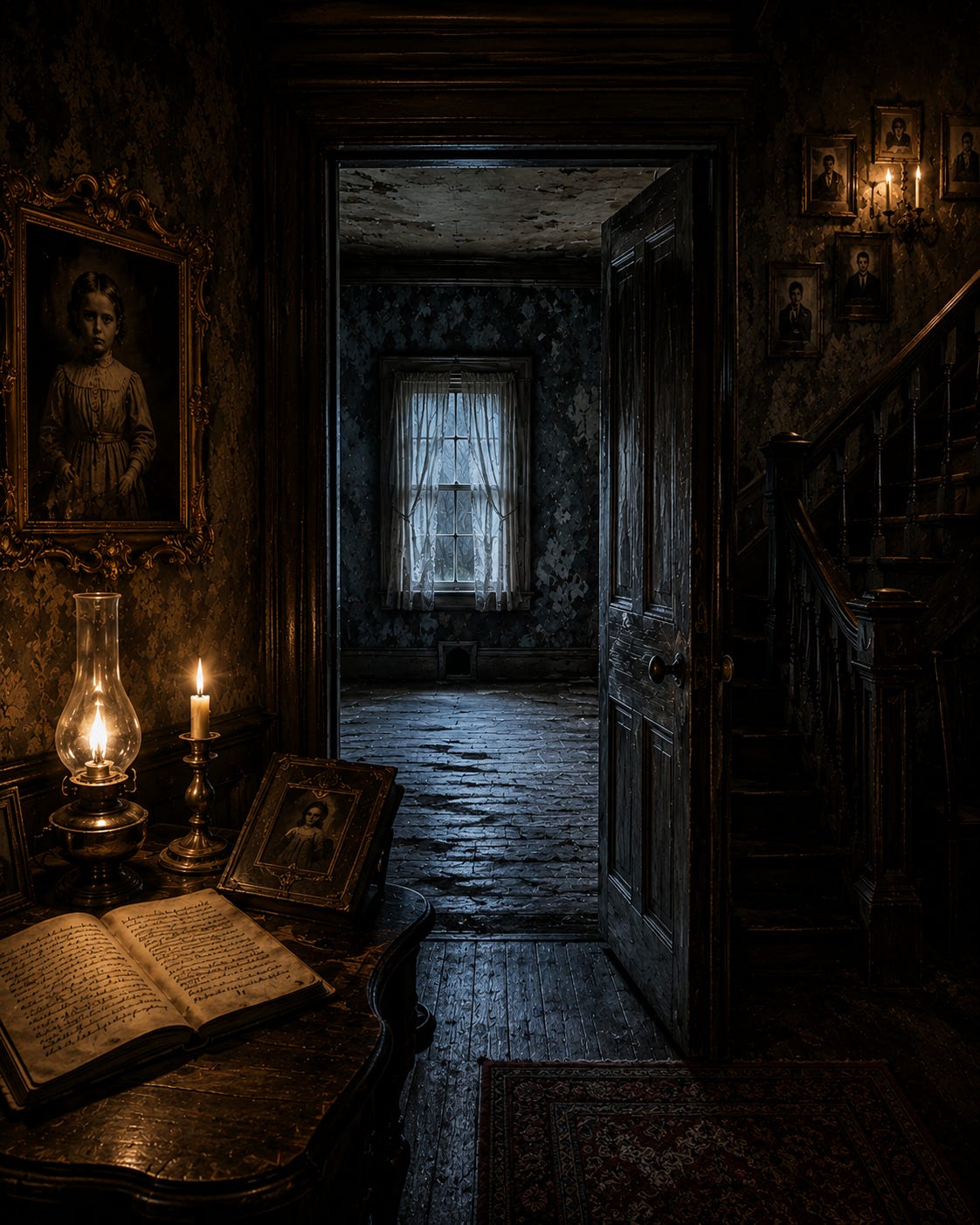
There stood, at the western extremity of Blackwood Hall, a chamber concerning which the oldest villagers spoke with uncommon reluctance. It possessed no remarkable feature to distinguish it from the remaining apartments of the house. Its hearth was cold, its walls bore faded paper, and a single window overlooked an orchard surrendered long ago to weeds and twisted branches. Yet no servant lingered within its threshold after sunset, and none could satisfactorily explain why.
When Miss Eleanor Ashcombe inherited the estate upon the death of her aunt, she dismissed such tales as the harmless inventions of country folk. Having received a sensible education and priding herself upon a practical disposition, she regarded superstition as the natural companion of loneliness. Nevertheless, she observed that even the oldest housekeeper crossed herself upon leaving the chamber, while the gardener refused to glance toward its window after dusk.
The room itself resisted every attempt to appear inhabited. Fresh flowers withered before morning. Pictures removed from other walls and hung above its mantel were invariably discovered resting upon the floor, their frames undamaged. Dust returned within hours of being swept away, and no fire, however carefully tended, would continue burning after midnight.
At length, curiosity prevailed over caution. One evening, Miss Ashcombe scattered fine ashes across the floor before locking the room and placing the key beneath her pillow. She desired only to determine whether rats or some other creature had gained secret entrance.
The following morning, the ashes remained smooth except for a single trail of footprints.
They began near the center of the room.
Each impression faced the doorway, yet none returned toward the place from which they had come. Indeed, there existed no indication that the unknown visitor had entered by any earthly means, for the first print commenced where bare floor should have remained untouched.
The village magistrate laughed upon examining them and declared the matter an elaborate deception. Mrs. Wilcox, the elderly housekeeper, displayed no such confidence. Her face lost all color, and she begged her mistress never again to enter the chamber.
“My grandmother warned me,” she whispered. “The room is not empty. It forgets.”
Pressed for explanation, the old woman refused another syllable.
That evening, Miss Ashcombe searched the attic until she discovered her great-grandfather’s journal concealed within a weathered sea chest. Most of its pages contained little beyond household accounts, but near the end appeared a passage written in a trembling hand.
“Should the chamber ever seem deserted, rejoice not. It forgets only for a season, and memory is ever followed by hunger.”
The remaining pages had been carefully removed.
Sleep deserted the house. Shortly before midnight, Miss Ashcombe awoke to the sound of measured knocking somewhere beyond her bedroom door. Four deliberate blows echoed through the silent corridor, followed by another four, each separated by an interval so precise that no mortal visitor could have maintained such dreadful patience.
Taking a lamp, she ascended the hallway.
The knocking ceased.
The chamber door, which she distinctly remembered closing, now stood slightly open. A cold current drifted into the passage, carrying with it the odor of damp earth. Beyond the threshold, the room appeared empty until the lamplight reached the far wall, where a second doorway had emerged from beneath the faded wallpaper. Fashioned of black oak and marked with strange carvings, it seemed older than the house itself.
Then a child’s voice spoke from the darkness.
“So many years,” it said. “Has everyone forgotten my name?”
The hidden door slowly opened inward.
No hinge uttered the slightest complaint. The ancient wood moved with dreadful ease, as though it had been opened countless times before, and had waited only for another soul sufficiently curious to witness what lay beyond.
It revealed no chamber beyond, but the hallway in which Miss Ashcombe stood holding her lamp. She saw herself upon the opposite side, pale and motionless, while another figure, unseen until that dreadful instant, stood quietly behind her.
The room had remembered.
And something else had followed.
2026 © Professor Mike: All rights reserved.
Very scary! I was not expecting that ending.