
Where Mirrors Keep Their Dead
A haunting tale of holy terror

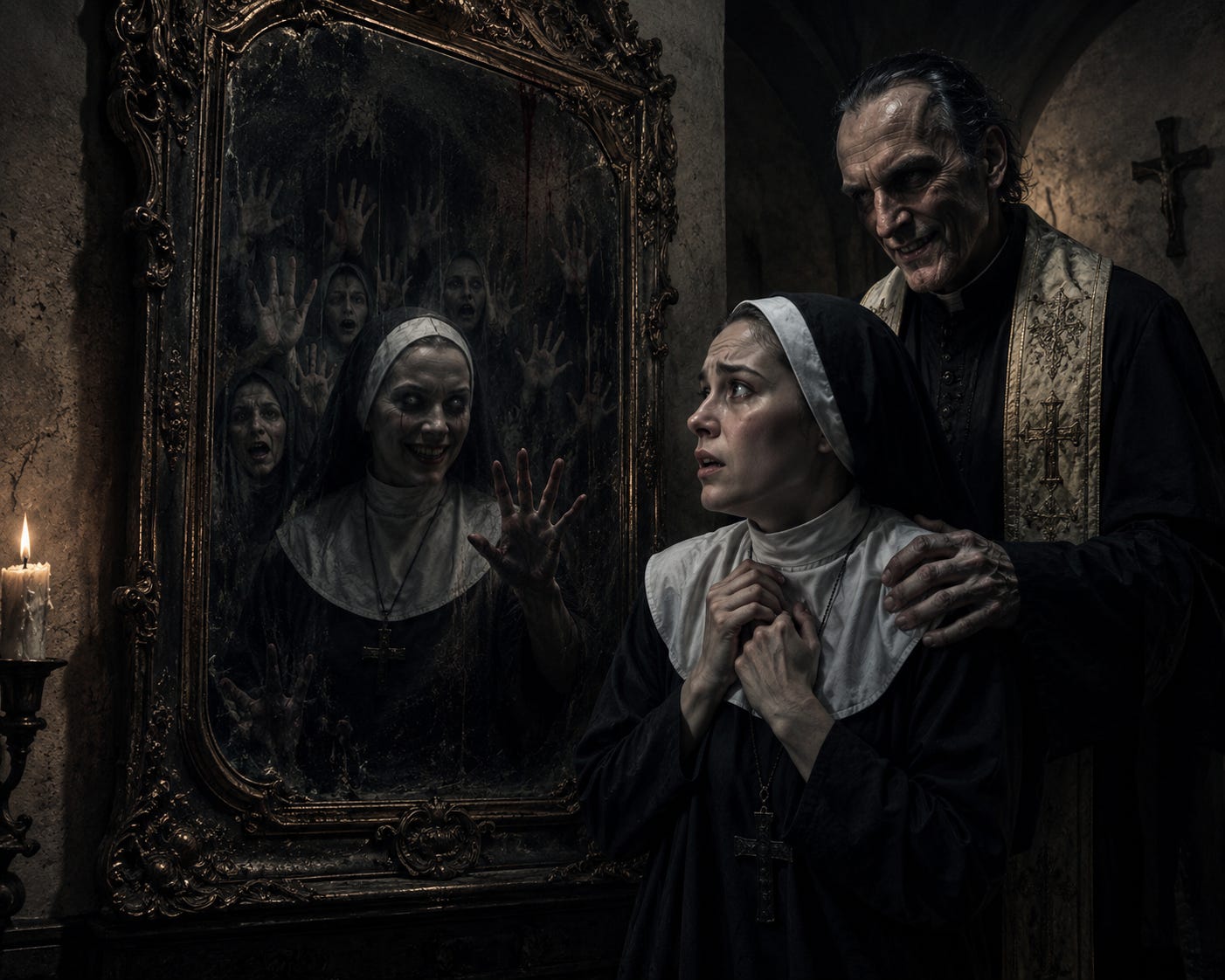
Never linger before an old mirror after dark, child… for that is where mirrors keep their dead.
— Michael Scott, 2026
The sisters of Saint Brigid’s Convent had long maintained that the ancient mirror hanging within the abandoned north passage ought never be looked upon after the Angelus bell. None could say when the custom had begun. Some claimed the warning had come from the convent’s foundress herself; others whispered that it was older still, belonging to the ruined monastery upon whose foundations the convent had been raised.
Whatever its origin, every novice obeyed the rule until Sister Agnes paused there one bitter November evening. Carrying only a taper, she lifted the trembling flame before the tarnished glass. Its carved walnut frame bore angels whose faces had acquired expressions of unmistakable grief.
She raised her candle. The woman within the mirror did not. Instead, the reflection regarded her with quiet amusement, as though it had patiently awaited this meeting. A chill unlike any earthly cold stole through her limbs.
Measured footsteps echoed along the corridor. Father Severin appeared, immaculate in black robes beneath a white stole. Throughout the district he was praised for holiness; within the convent he inspired silent dread. No sister ever departed his confessional comforted, and those receiving his private instruction seemed to age with alarming speed.
“You have looked,” he said softly.
“I meant no harm, Father.”
“Few ever do. It has awaited you.”
The reflection slowly inclined its head toward the priest with unmistakable familiarity.
Father Severin produced an ancient iron key and opened the abandoned chapel. Though every instinct urged flight, Agnes followed as though compelled by another will. Every crucifix hung inverted. The altar stood bare. Occupying the eastern wall rose an immense mirror whose surface shimmered faintly in the candlelight.
Agnes saw not merely herself but hundreds of women clothed in convent habits. Some prayed. Some wept. Others struck the invisible barrier imprisoning them.
“Our congregation,” Father Severin murmured.
Each imprisoned face watched Agnes with desperate expectation. Some mouthed prayers; others shook their heads in frantic warning. One elderly nun traced the sign of the cross, then pointed toward Father Severin with trembling fingers. He merely smiled, as though blessing faithful children gathered before Sunday Mass once more.
The great mirror trembled. Faces pressed beneath its silver surface like drowning souls beneath winter ice. Then Agnes beheld a face she recognized beyond all doubt.
Her own.
Its lips formed silent words.
Do not believe him.
Father Severin smiled with dreadful satisfaction.
“For forty-three years I have preserved appearances rather than souls.”
He loosened the collar about his throat.
The flesh parted without blood.
Within the darkness waited a countenance possessing innumerable eyes and smiling mouths. Every gaze rested upon Agnes with patient hunger.
Beside him, her reflection stepped calmly through the mirror without disturbing its surface. It wore her face perfectly, save that its smile contained neither mercy nor pity.
Memory did not return gently — it tore through her like glass driven into flesh. She remembered screaming until her throat split. She remembered hands — so many hands — dragging her inward while something else climbed out, wearing her skin like a garment still warm. She remembered the moment the world went silent, replaced by the suffocating press of other souls, all of them watching, all of them waiting.
She had never escaped.
She had never even been Agnes.
“You have slept beautifully,” her double whispered, voice thick with something almost tender — and utterly false.
Father Severin extended his hand.
The mirror did not ripple. It opened.
Agnes clawed at the air, at the stone, at anything that might anchor her to the world — but there was nothing. There had never been anything. The pull was absolute. The glass swallowed her without resistance, sealing her scream behind a surface that reflected only calm.
The convent bell tolled.
The sisters came.
They found Father Severin speaking warmly with Sister Agnes, whose eyes shone with a serenity so complete it bordered on the unnatural. Her smile lingered too long. Her gaze held too steady. But no one questioned it. No one ever did.
Behind them, the mirror stood silent.
Until one looked closely.
Until one saw the shapes beneath it — hands, faces, mouths opening in endless, soundless pleas — pressing, pressing, pressing against a barrier that would never break.
Years passed.
Pilgrims came.
They spoke in hushed awe of Saint Brigid’s Convent, where peace reigned with unnatural perfection. Where every sister obeyed without hesitation. Where every prayer was answered with silence so complete it felt like suffocation.
Only the oldest villagers refused to enter.
They spoke of reflections that lagged behind movement. Of shadows that bent the wrong way. Of a priest who never aged, who knelt each night before the ancient mirror in rapture.
And of what stood behind the glass.
Something wearing the face of Christ.
Something smiling with Agnes’s lips.
Something raising a blessing — slowly, deliberately — with fingers that were not fingers at all, but long, jointed claws that scraped softly against the inside of the world.
Michael (Professor Mike) writes at Medium.com, as well as other publishing outlets. He is presently on his third draft of a fantasy novel with the working title of Dogs and Devils.